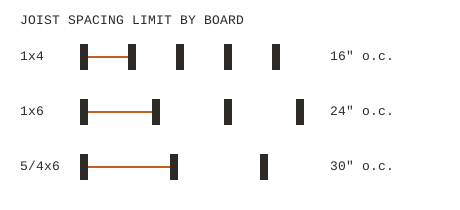
The published conversion, span and property figures for Ipe decking and porch flooring, in the order they are used when a deck is drawn.
- Family name
- Tabebuia avellandedae, Tabebuia ipe and Tabebuia serratifolia, of the family Bignoniaceae
- Common names
- Ipe, pau d'arco, ipe tabaco, bethabara, lapacho, ebene vert, amata prieto, ironwood, greenheart, amapa, cortez, guayacan, guayacan polvillo, flor amarillo, madera negra, tahuari, lapacho negro, Brazilian walnut
- Height and weight
- Trees routinely grow to 150 feet and can reach 200 feet, with trunk diameters of 6 feet and boles clear to 60 feet or more. Weight varies between 60 and 75 pounds per cubic foot, with a specific gravity of 1.08
- Dimensional stability
- Stable, with minimal checking and warping
- Maintenance
- Low
- Fire rating (NFPA)
- Class A
- Resistance to insects and decay
- High
- Movement in service
- Low
- Weight (lbs per cubic foot)
- 60-75 lbs
- Bending strength (psi)
- 26,000
- Modulus of elasticity (psi)
- 3,308,000
- Hardness (psi)
- 3,650
The material usually air dries rapidly with very slight checking or warping. It can be difficult to work and difficult to saw, and its hardness has a blunting effect on cutting edges. High quality carbide and diamond tipped blades are recommended, as is pre-drilling when surface fastening. Machining generates a fine yellow dust that may cause breathing problems and dermatitis. Ipe is highly resistant to insect and fungal attack.