Start here: the Ipe decking manual
Eight stages, in the order the work is done, from identifying the board to sealing the finished deck.
- 01Product Information
What Ipe is, where it grows, how dense it is and why it is pre-drilled before surface fastening.
- 02Design / Build
Footage conversion, recommended joist spacing, mechanical properties and span values by load.
- 03Product Information
How deck areas are described in feet, and the five to ten percent allowance carried for miscuts.
- 04Design / Build
Face screwing, hidden clips and biscuits, under-mount brackets, plugs, and why stainless is used throughout.
- 05Design / Build
Paraffin wax emulsion applied to fresh cross cuts to hold back end checking as the board loses moisture.
- 06Design / Build
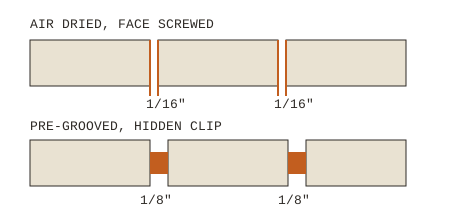
One sixteenth of an inch side to side on air dried boards; no added gap on kiln dried grooved and tongued stock.
- 07Product Information
Cable, glass and powder coated systems, and the baluster layout arithmetic that holds the opening under four inches.
- 08Design / Build
Scrubbing rather than stripping, why sanding is irreversible, and the three step sequences for finishing.
New writing
More
Most domestic and imported hardwood dust is treated as a breathing hazard, so a dust mask is worn when cutting or sanding, and Ipe is heavier and denser than most other decking woods, so lifting quantities should never be judged against softwood habits.
Every span, gap, dimension and quantity in this manual is the figure published for Ipe Decking Source lumber; local building requirements govern the finished installation.
Product Information
Species, common names, density, fire rating and working characteristics.
Decking, porch flooring, railing components and dimensional stock by size.
Stainless trim head and deck screws, hidden fastening kits, accessories and end sealer.
Stainless cable, tempered glass and powder coated steel railing systems with post caps.
How a project is described in square and lineal feet before material is cut.
Design / Build
Conversion, span and mechanical property tables for each board size.
Storage, tools, sealing, fastening, gapping, sanding and finishing in working order.
Kiln dried against air dried, jig systems, and how Cumaru and Massaranduba compare.
Marking sub-rails from the centre out and repeating the layout on stair sections.
Applications recorded for the material: pergolas, docks, porches, stairs, siding and gates.
Sourcing
Permit driven selective cutting, contracted mills and the paper trail from forest to export.
Dated entries from the 1999 fastener beginning to the later lumber and railing brands.
Every chapter in the manual, grouped as published.
Tools
- Circular saw blade
- carbide tipped, 16 teeth on 7-1/4"
- Mitre saw blade
- 24 teeth on 10", 32 teeth on 12"
- Drill bit
- cobalt alloy, 9/64"
- Forstner bit
- 3/4", for hardwood sub-rails
- Driver bit
- T-10 star for trim head screws
- Board bender
- self locking, for crooked boards
- Deck brush
- medium to stiff bristle
- Dust mask
- worn for cutting and sanding
Hardwood dust is treated as a breathing hazard. Ipe is heavier than softwood of the same size.
Materials
- End sealer
- paraffin wax emulsion, 1 quart covers about 1,000 SF
- Face screw
- type 316 stainless trim head, 8 x 2", 3/16" head
- Hidden fastener kit
- 175 biscuits and 175 screws per carton
- Deck cleaner
- concentrate, about 150-200 SF per spray bottle
- Hardwood finish
- water-borne, about 250 SF per gallon
Related chapters
Finishing
- Working temperature
- sustained above 50 degrees F
- Drying before finish
- at least 2 hours after rinsing, longer under cover
- First coat
- brushed in, 4" brush
- Later coats
- pad or roller, applied immediately, 2 coats minimum
- Stirring
- every 20 minutes to stop settling
- Working width
- 2-3 boards at a time, full length
Sanding before an oil based product shortens its life and cannot be undone.
Conversion
- 1x6 decking
- 100 SF = 220 LF
- 1x4 decking
- 100 SF = 343 LF
- 1x4 T&G porch floor
- 100 SF = 370 LF
- Cutting allowance
- 5-10% over the measured footage
Joist spacing
- 1x4 — 16" o.c.
- 1x6 — 24" o.c.
- 5/4x6 — 30" o.c.
Maintenance
- 01
Cleaning
A light scrub with a medium to stiff bristle brush and a non-harsh cleaner removes ground-in dirt. Cleaners sold on the strength of bleach are avoided on new wood because bleach can lighten the colour prematurely.
- 02
Pressure washing
Pressure washing strips old sealer residue and a high pressure will not burr the surface, but it is not the first choice on new decking, where high pressure can stripe the wood. Machines above 2,000 psi are the effective range when old oil residue has to come off.
- 03
Oiling
Oiling is not required. Ipe weathers to a silver-grey patina under ultraviolet light, and a hardwood inhibitor only slows that change.
- 04
Sanding
Sanding permanently removes the nap from the surface, which stops an oil based product penetrating. Sanding is irreversible; a water-borne film former is unaffected by it.